South Harris

Yesterday we left Stornoway and headed down to the Isle of Harris, which is actually the other end of the Isle of Lewis.

Lewis_-_Harris_Islands

The line between the two is not well defined
image: http://en.wikipedia.org/wiki/File:Lewis_-_Harris_Islands.PNG

Andreas and Kosta got off the bus in the main port town, Tarbert, to find a B&B and then take a walk until dinnertime. I stayed on the bus for the village of Northton, where Bill Lawson has his Western Isles genealogy center.

IMG_9565

Northton is a tiny village consisting of one main road running perpendicular to the highway with maybe twenty houses on it.

IMG_9563

About halfway down the street is an honor system fresh farm shop:

another shop selling tweed items is all the way at the end of the road:

IMG_9559

There is also a cafe that has a good reputation but it was closed yesterday for a private wedding.

The young man at the Seallam Visitor Centre connected me with Bill Lawson and his wife by phone (they live next door but were having an at-home day). I told them everything I know about my immigrant ancestor. They searched their database for me and were able to eliminate one more of the John Murdo MacIvers but alas, without least one more date or a relative’s name, there are still three candidates. I bought a couple of books about Stornoway, but that was all I could do, family history-wise, on this trip.

It was only 2:00, and the next bus back to Tarbert was at 5:00, so I decided to go for a walk out to a ruined late medieval chapel by the sea.

This slideshow requires JavaScript.

It was a beautiful walk, but I mistimed it slightly and missed my bus by 10 minutes. No matter, I could still get the last bus at 6:15 and be back in time for the 7:00 dinner I had arranged with Andreas and Kosta.

Well.  I will skip the boring details, but it turns out I had actually missed the last bus. I was slightly panicked at that point. It was too far to walk to Tarbert, and there were no sort of public services in Northton, nor any hotels or lodging. I don’t have a phone that works here, and (rather surprisingly, since they are everywhere else in Scotland) there was no public phone box.

If you are going to be stranded, I highly recommend you do it in Scotland. This must be the friendliest, most helpful country in the world. I saw a woman and her daughter reading in their yard, and I asked them if there was any such thing as a taxi or car service. They were on holiday and didn’t know but they directed me to another house with locals in it.

The older gentleman there was very sympathetic and blamed the public transit cutbacks for my non-existent bus (generously disregarding my inability to read a bus schedule as the root of my problem). But, he said, wait a moment – and disappeared back into his house. A moment later he reappeared, announcing that my troubles were over – his daughter would drive me to Tarbert.  So, with no other viable options, I accepted their kind offer.

I had a lovely chat with Becca in the car.  It turns out she is a weaver of the famous Harris tweed, an occupation she can pursue from a shed at the back of her dad’s house. Working from home enables her to care for her disabled brother at the same time. What a lovely person. Scotland continues to amaze me.
Posted in Elsewhere, Islands | Tagged , , , , | 1 Comment

Stornoway man

Where are you, Murdo?

murdo

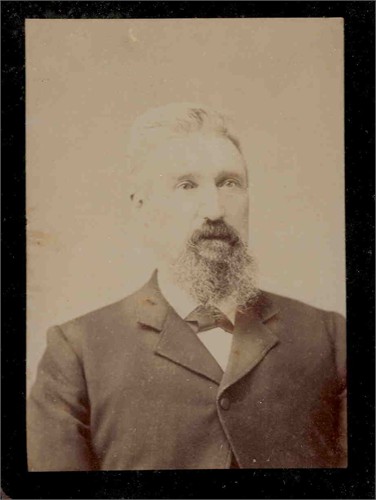
My grandfather’s grandfather, John Murdo MacIver

One of the things that keeps drawing me back to Lewis is the family connection. This is my third trip here. Each time I come armed with a little more information, but it’s never quite enough to pin down my elusive ancestor.

John Murdo (or Murdock, or Murdoch) MacIver is fairly well documented after he emigrated to America around 1850.  In 1854 he married a young Irishwoman named Sarah Dwyer in Boston. They had five children there, then in about 1862 the family sailed around the Horn to relocate in San Francisco’s South Park neighborhood (yeah, I know, haha) south of Market Street. Murdo worked as a rigger, stevedore, and later a loading foreman on the city docks.

Sarah died in 1874, leaving Murdo with eleven children aged one to 19. The older daughters found work as seamstresses, and the oldest boy left home for Chicago. A few years ago Murdo’s house was the subject of an archaeological study. (If you’re a MacIver relative interested in our SF ancestors, the study has a lot of detailed information; there is a nice bit about their family life here (search the document for “Mary McIver”).

Murdoch died in 1903 but he was still remembered by old-timers in 1927: “Murdock Mclvor, who worked as a longshoreman, was another celebrated Scotchman of his day. He was a member of all the different Scottish Societies, and was a famous Quoit Player, and participated at the various gatherings of the clubs.” (James H. Roxburgh, “Memories of the Past.” South of Market Journal. May, 1927.  p 14)

Unfortunately some key pieces of information about Murdo’s early life were lost in the Great Earthquake and Fire of 1906. The earthquake was a watershed event in my family’s story, a disaster that had repercussions and significance down the generations. For me, it has set up a brick wall in my research, because the death records of both Murdo and Sarah were destroyed, along with the marriage records of their children and (so far as I have been able to determine) Murdo’s naturalization records. I don’t know whether these records would have given me an accurate birthdate or the names of relatives in Scotland, but whatever was there is gone forever.

I did make a serendipitous online connection a few years ago with a distant cousin, a descendant of Murdo’s Chicago son. He sent me this photo, of Murdo with his second wife posing at the site of the family gravemarker they have just put up. The marker gives dates for the new wife’s brother and Murdo’s first wife, Sarah; the setting is San Francisco’s old Odd Fellows Cemetery, where Murdo also was later buried. The cemetery, the stone, and the original records were all destroyed in the 1930s, the bones reinterred at Greenlawn in Colma. I was thrilled to get this photo – and thanks to those old view cameras, you can even read the writing on the stone. But what a strange thing to take a photo of.

Murdoch McIver grave

At any rate, pre-Boston Murdo has me stymied.

Although family lore had it that he was from Inverness, Murdo reported in the 1860 census that his birthplace was Stornoway, and he ought to know. Maybe he sailed from Inverness or lived there for a time before he emigrated. He named his second son (my great-grandfather) Lewis, an unusual first name in Scotland but one which (as I learned on this trip) is traditional among the MacIvers of Lewis.

IMG_9177

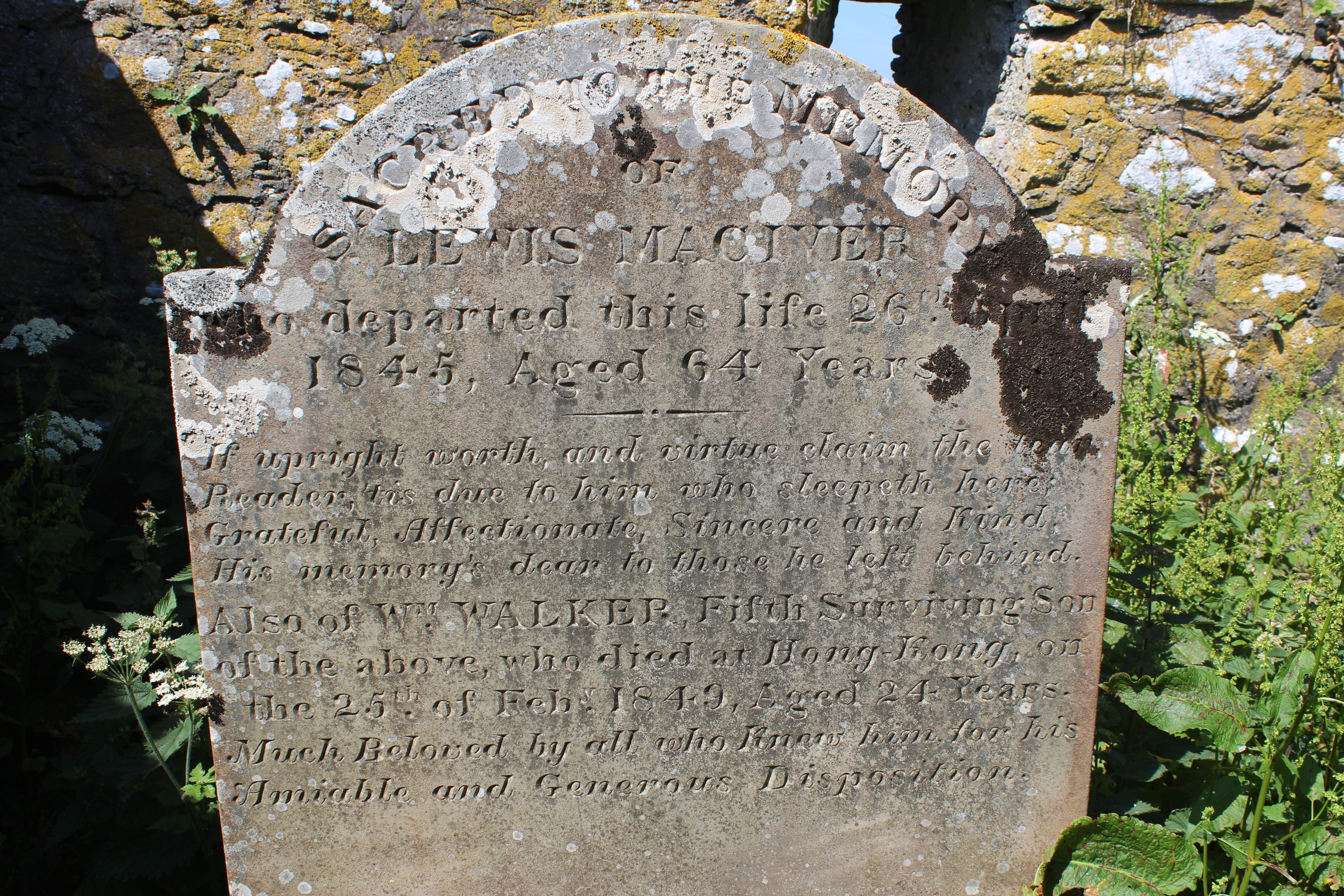
One of many dead Lewis MacIvers on the island

I am sure Stornoway or somewhere near it was my Murdo’s hometown. But the problem now is, which John Murdo MacIver was he? A name like that would be unique most places in the world, but there are at least three men born here around that time who could be my Murdo.  There were five but this week I was able to eliminate two from the running.

IMG_9125 - Copy

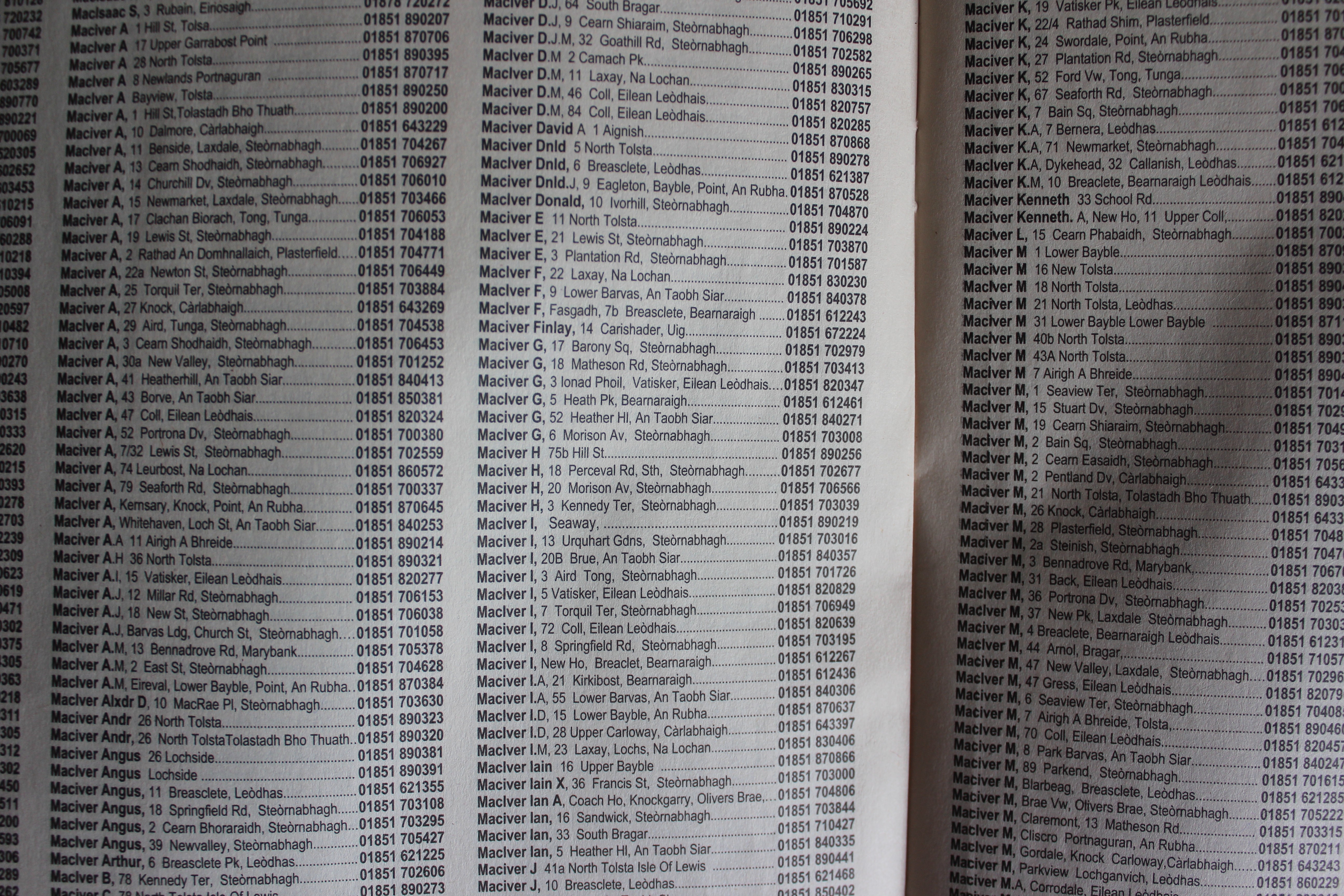
MacIvers in the outer Hebrides phone directory

A VERY helpful librarian at Stornoway’s public library guided me through the various resources available there. I learned that the ownership of every croft in every village on the island has been thoroughly documented through many generations. The fellow who wrote up and published these croft histories is named Bill Lawson and he lives in Harris (the Isle of Harris, as I may have mentioned, is actually the southern end of the Isle of Lewis). He recently established a family history research center called Seallam! in Northton, where he lives. I decided to go there. But I’ll save the rest of that story for tomorrow.

Posted in Elsewhere, Family, Islands | Tagged , , , , , , | 1 Comment

Cam ye o’er frae France?

Today Andreas and I had the very happy task of picking up our son Kosta at the Stornoway airport. Andreas hadn’t seen Kosta for more than two years; I saw him at Christmas, but that’s still too long ago in my book.

Kosta is working on his Ph.D. in computational physics.  He was at a conference in Aix-en-Provence these past two weeks (something tells me the Festival de Theorie didn’t bear much resemblance to the HebCelt Festival).   He arranged to take a little more time off from his research on plasma turbulence at sub-proton scales to meet us for a week in the western isles.

It’s Sunday, and Sundays are a special day on Lewis. Religion, governed here by the Free Church of Scotland in a few different varieties, informs island life to an extent most Americans are no longer familiar with. Sunday is reserved for rest and worship, and that means no buses, no shops, no museums, and no restaurants other than a couple of hotel cafes and an Indian takeaway. In the mystery novel Black House, set in Lewis, the author Peter May mentions that until recently the swings at the children’s playground were tied up for the Sabbath. There was an extra ferry out of Stornoway last night: most visitors don’t want to get stuck here on a Sunday.
IMG_9175

Although there are no Sunday ferries, the airport operates with a skeleton crew to meet the one incoming flight from Edinburgh. We picked up a rental car yesterday to use today (great fun with an Ethiopian driver’s license: try explaining the difference in numbering years.  Well you see it says it expires in 2007, but in Ethiopia that’s really 2015…no really…).

After picking up Bonnie Prince Kosta we set out to tour the island. Here’s what we saw:

This slideshow requires JavaScript.

Posted in Books, Elsewhere, Family, Islands | Tagged , , , | Leave a comment

HebCeltFest

I am music-deprived in Ethiopia. I long for hot summer nights on the lawn at Jacksonville’s Britt Festival. Sure, I can hear regional ethnic Ethiopian music at Dimma restaurant any night of the week. And we have some teacher friends who play in local bands –  the rock-n-roll cover band Germaricans; the all-ICS-staff Urban Hyenas; also the Ethiopian-style jazz quartet Jazzmaris that our elementary music teacher Olaf plays with.

But there’s not much in the way of outdoor venues in Addis, nor is there a lot of variety in the musical styles on offer. Let’s face it, Addis Ababa is rarely part of any big-name musical world tour (though maybe Joss Stone will get here eventually).

So we made sure our summer plans included some live outdoor music. We couldn’t get to Orkney in time for the St. Magnus festival, but we managed to work it just right to hit the Hebridean Celtic Festival, or HebCelt for short. It’s a great time to visit Stornoway; the festival brings out the best of Lewis.

This slideshow requires JavaScript.

HebCelt showcases a wide variety of Celtic-influenced music, from traditional bagpipes, drums and Gaelic songs, to world music, punk, rock, and folk – all with a Celtic flavor. Headline bands this year included Van Morrison, Capercaillie, The Battlefield Band, and Dougie Maclean. Then there were local favorites like Face the West and Karine Polwart.  I discovered new favorites of my own, including The Travelling Band and Rose Parade (finally, some new CDs to play in the truck!)

This slideshow requires JavaScript.

But the highlight of this festival was the Red Hot Chilli Pipers, and the incredible sight of 3,000 young people (and some not-so-young people) screaming and shouting and jumping up and down for…  bagpipes. You would have thought it was the Beatles.

Posted in Addis Ababa, Elsewhere, Islands, Music | Tagged , , , , , | 1 Comment

Donald where’s yer troosers?

Part of the reason we picked these particular dates to be on Lewis was so we could attend the Hebridean Celtic Festival. More about the festival tomorrow, but for now I’ll just say it’s a great place for kilt-spotting. Here are a few examples of music festival garb, Stornoway style (best viewed with musical accompaniment by Enter the Haggis, see below)

This slideshow requires JavaScript.

There are a few vendors at the festival selling some choice local products. The best one was Lewis clothing designer Diggory Brown (real name Netty Sopata).

Check out the website for some unique, made-to-order island wear.

Posted in Elsewhere, Islands | Tagged , , , , , | 1 Comment

Mathain va

Having proven myself unable to learn Arabic and Amharic, why would I think I could learn Gaelic?  Consistent failure doesn’t stop me from trying.

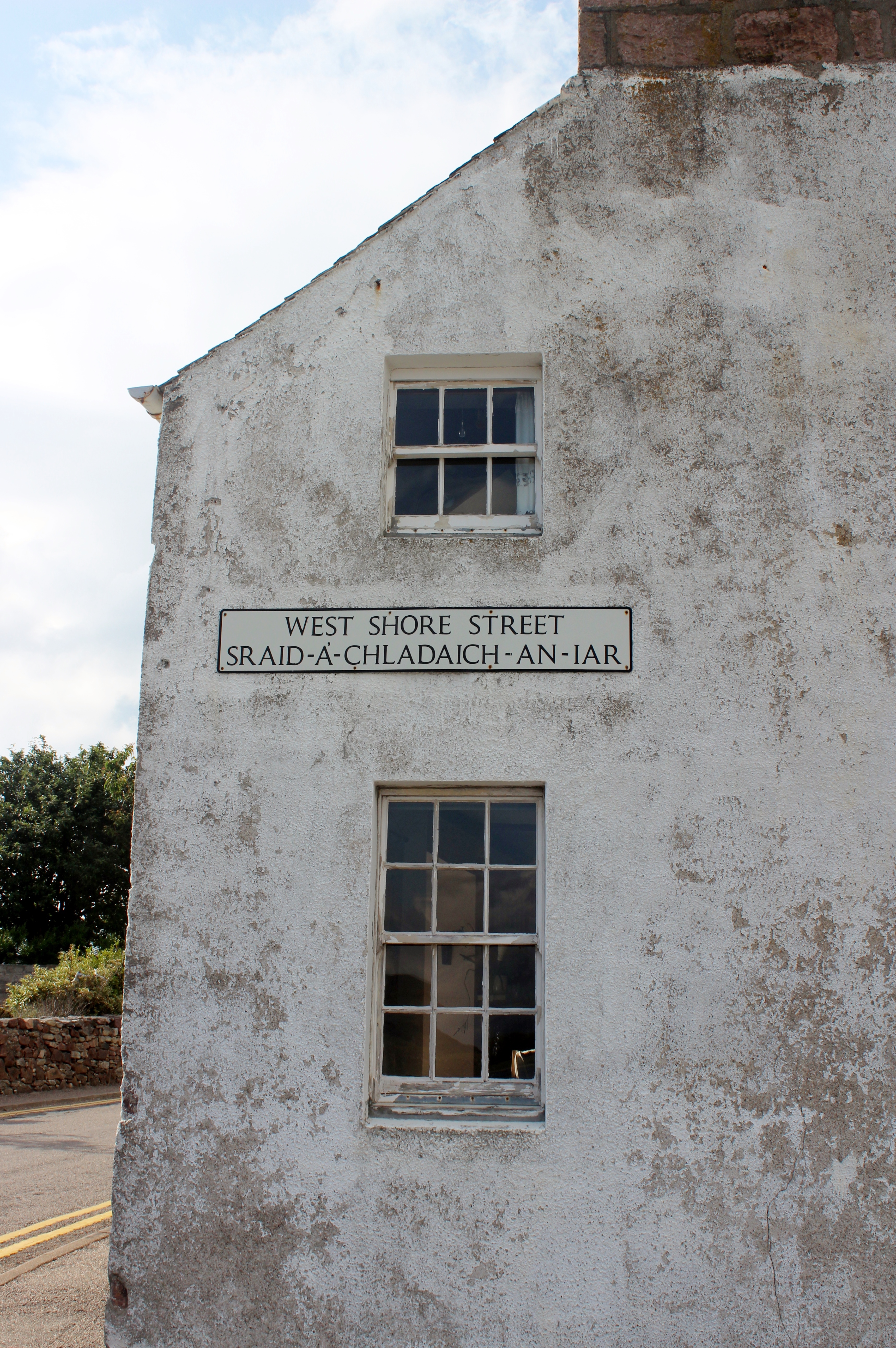
About 60% of people in the western isles speak Scottish Gaelic. The highest proportion of Gaelic speakers in all of Scotland is in northern Lewis at 75%.  Signs, announcements, etc. here are in Gaelic first, English second.

Sometimes Gaelic looks like something I could learn. There seem to be lots of extra letters involved, but you can almost sound it out:

IMG_8931

Other times it looks pretty daunting:

IMG_8939

I went to a 2-hour “taste of Gaelic” class yesterday at Stornoway’s cultural center, An Lanntair.

This slideshow requires JavaScript.

At the end of the class I could say good morning, my name is Lorna, how are you, I am very well, I’m not bad, I am too hot (there’s a heat wave going on just now), thank you, indeed, do you have..?, and I’m sorry. But by this morning all I remembered was “good morning” – mathain va (phonetic spelling; we didn’t do any writing in our two hour lesson).

I tried out my new phrase on Ann, our Gaelic speaking landlady at the bed and breakfast. Of course she responded with a long string of incomprehensible words. Oh well. I just smiled stupidly and asked for a bowl of porridge. In English.

Posted in Elsewhere, Islands | Tagged , , , , , , | Leave a comment

Heart of Brave

Woo hoo! Here we are in Lewis, land of my people! (the MacIver ones, anyway). We’ll be staying for a few days in Stornoway, the capital.

IMG_9076

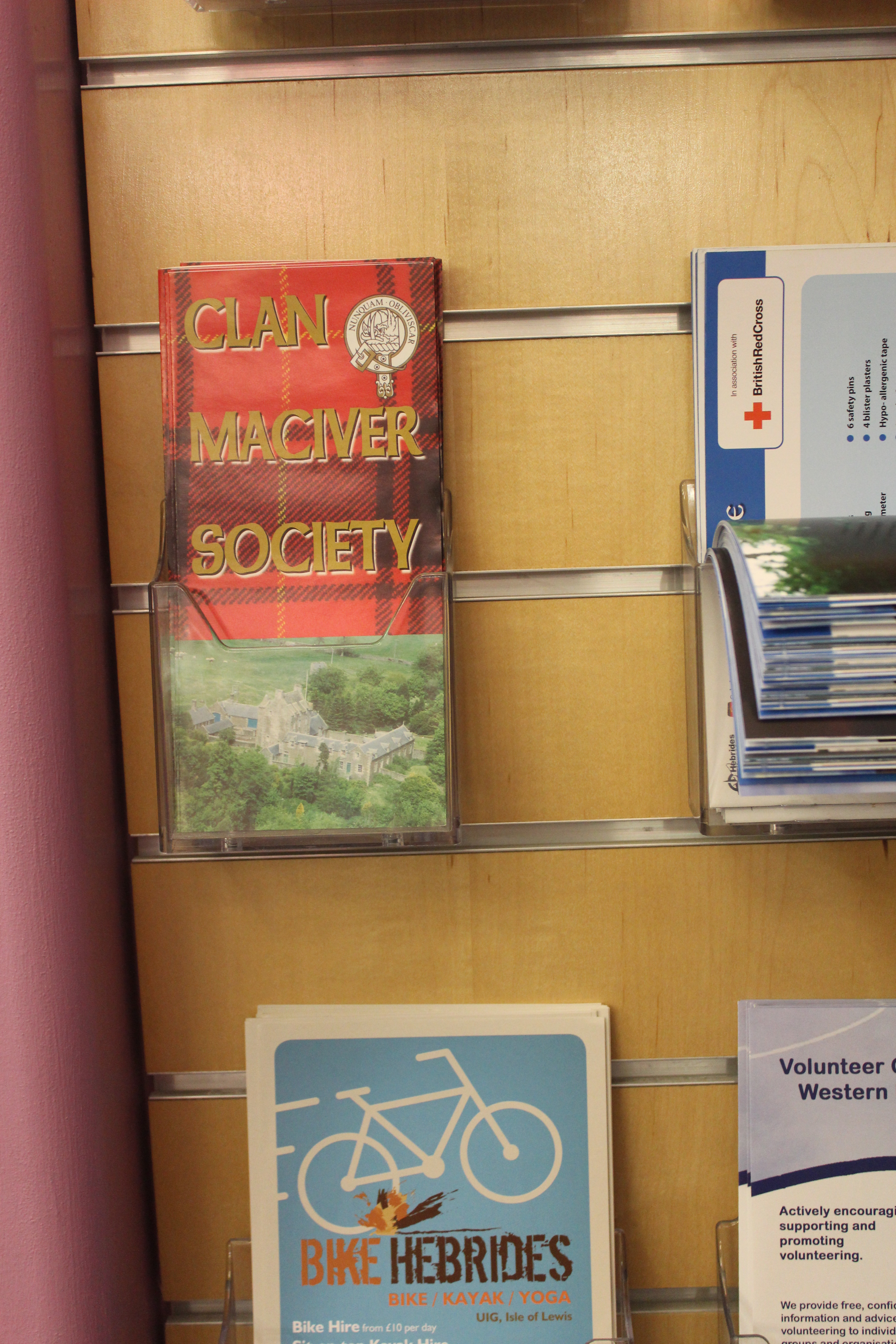
Brochures in the public library in Stornoway

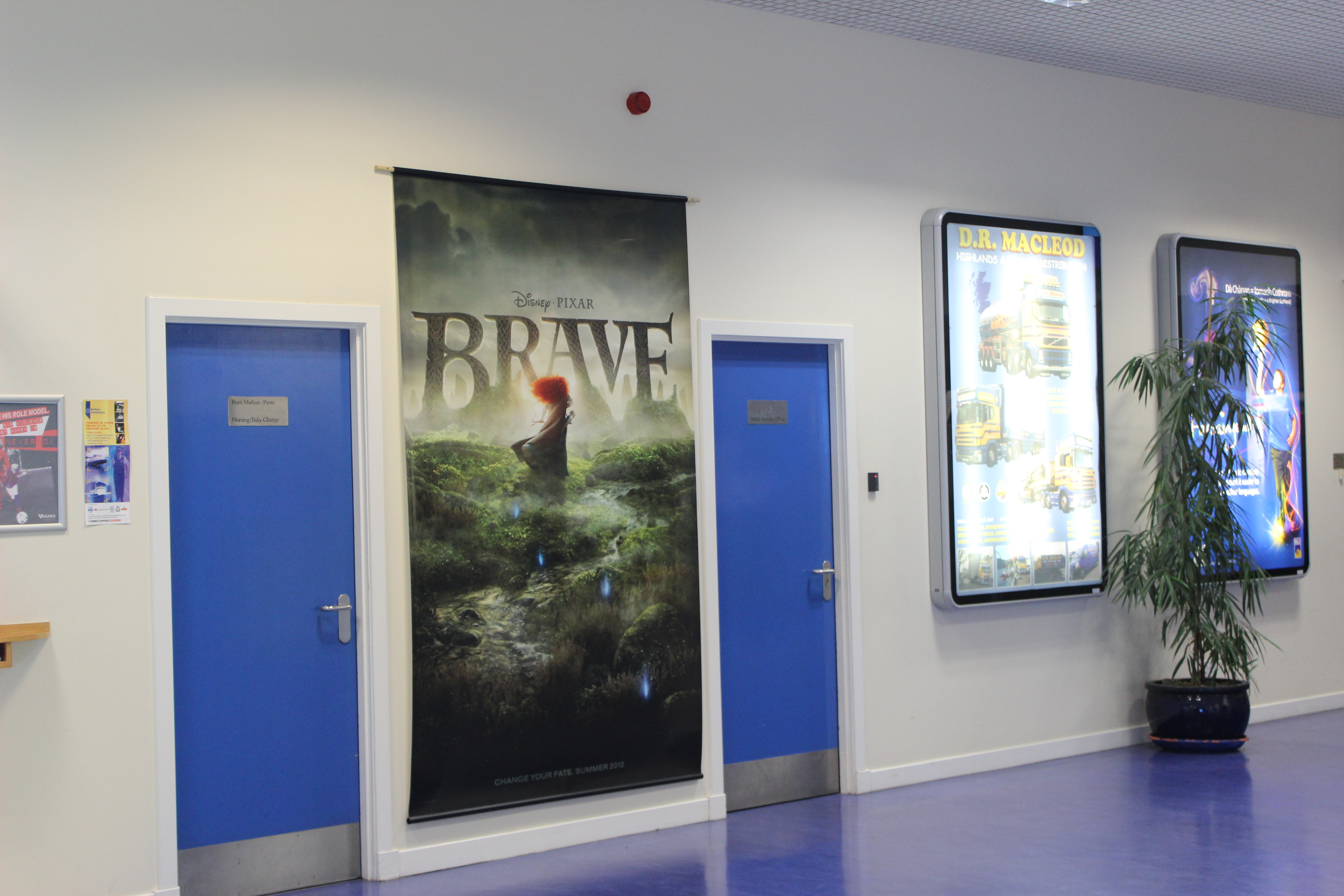
This is also the land of the Disney film, Brave.

IMG_9262

Stornoway airport

I did not know this until Alekka finally talked me into watching the DVD with her this last spring. Hey! Those are the Lewis chessmen.

lewis chessmenAnd the Standing Stones of Callanais!

kinopoisk.ruAnd then (the clincher) – the witch says she’s going to a coven in… Stornoway!

witchI looked it up. The research team was all over the western isles, but they drew the setting mainly from Lewis.

Our 15 minutes of fame.

Posted in Elsewhere, Islands | Tagged , , , , | 1 Comment

All the way to Ullapool

A couple of days ago I happened to see a poster advertising a “Ferry and B&B Offer” in the window of the NorthLink ferry terminal. This offer turned out to be the best bargain we’ve encountered this summer.

The morning ferry from Stromness, Orkney to Scrabster in Scotland departs at 6:30 am, which is a bit early for some folks (like us). With the B&B deal, you board that ferry at 10 pm the night before.

IMG_8915Aboard MV Hamnavoe you get a small stateroom  with a private bathroom, coffee- and tea-making supplies, and internet. The ferry departs in the morning whether or not you are awake to see it leave the harbor. A full Scottish breakfast in the ship’s restaurant is included. You arrive in Scrabster well-rested and fed at 8 am.  And the price for the whole package was less than what we’ve been paying for B&Bs that don’t include a boat trip to Scotland.

This slideshow requires JavaScript.

We spent the rest of today making our way across the highlands. We first took a bus from Scrabster to Inverness and then transferred to another bus from Inverness to Ullapool, a pleasant fishing village on the west coast.  We will catch the morning ferry here to our next island destination.

This slideshow requires JavaScript.

One of the nicest things about Ullapool is that it is a sort of center for traditional music. This group of young people played after dinner in the cafe.

Posted in Elsewhere | Tagged , , , | Leave a comment

Here comes the rain again

On our last full day in Orkney we made a day trip to the island of Hoy.

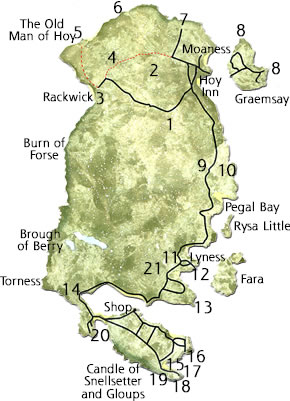
map of hoy

image: http://www.visitorkney.com/hoy/
You’ll need to check out Visit Orkney if you want to know what all the numbers mean

The largest village, Lyness, is on the southeast coast of the island but we bypassed the big city (just kidding: the entire island of Hoy has a population of 272) and took the passenger ferry from Stromness to Moaness, in the north. It was a pretty rough ride but we made it.

There we were met by a van driven by an amusing and voluble chap who filled our heads with local lore as he transported us across to the western side. He dropped us off at Rackwick, population 1 or 2, plus quite a lot of sheep.

IMG_8716We followed a path to the Old Man of Hoy, a tall rock stack at the north of the island. The scenery on our 3-hour walk was spectacular despite the drizzle, mist, and wind.

This slideshow requires JavaScript.

Returning to Rackwick, we stopped in at the free museum of island life, really just one of the old crofts that has been kept as it was before the last family member moved away to town.

We explored a little more around Rackwick

IMG_8822Then the van came back to get us. We had an hour or so before the ferry arrived, so we stopped in the little cafe at Moaness for tea and a scone, then waited at the pier for our boat back to Stromness.

This slideshow requires JavaScript.

Hoy is the setting for this 1980s Eurythmics music video. Enjoy a blast from the past.

Posted in Elsewhere, Islands | Tagged , , , , , , | 1 Comment

Neolithic Orkney

Among the many amazing sights to be seen in this place are the Neolithic monuments. Everyone’s heard of Stonehenge in southern England, but not everyone knows that the British Isles are positively littered with stone age ruins.

Orkney, as you can see if you go to the site linked above and click on the right square, has a high concentration of ancient sites.  On Mainland there is one part of the island (“Heart of Neolithic Orkney” on UNESCO’s World Heritage list) where there are many apparently related sites. There are henges, standing stones, and cairns that seem to point to each other and which thousands of years ago may have served as an integrated religious center for the region.

Maes Howe, the Standing Stones of Stenness, and Skara Brae are the best known of the Orcadian sites and are on most tourist itineraries. Visiting these sites means sharing the space with busloads of visitors, but they are still worth it.

This slideshow requires JavaScript.

But it’s more fun to go to the lesser-known sites, where you can have the place to yourself to imagine what it might have been like here thousands of years ago.

This slideshow requires JavaScript.

Posted in Elsewhere, Islands | Tagged , , | Leave a comment