From our roving reporter

My daughter Alekka reports on her Grade 10 Week Without Walls experience in…

GONDOR

Oops, wrong map. Gondar and Lalibela…
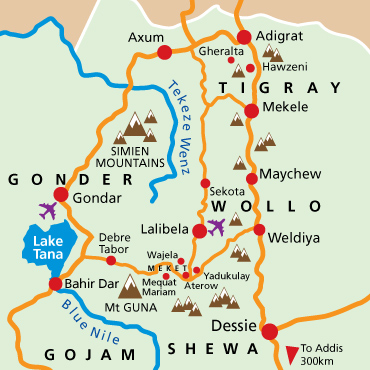
GONDER AND LALIBELA

Every year at ICS each grade level takes a trip. Freshmen always go to the Bale Mountains, juniors to Woliso, and… I’m not sure where the seniors go, it’s some sort of service project… anyway, lucky for me, I’m a sophomore so instead of altitude sickness in the mountains or malaria in the southern region I got to go on the trip to Lalibela and Gondar where the worst thing that can happen is a broken down van.

OLYMPUS DIGITAL CAMERA

Guards pushing our broken-down van

The class trips are basically meant to be team-building-service-learning-historical-crash courses.  Or, in other words, Good Experiences. This, I think, is why they make us leave our computers and cellphones at home. On the six day trip, a lot of time was spent hanging out on the terraced roofs of the hotels playing card games, but we also got to see some great historical sites.

OLYMPUS DIGITAL CAMERA

What we mostly did.

Gondar has some fantastic castles that we checked out on our first day.  Our guide told us that he was the man who taught Beyonce that Ethiopian shoulder dance that she does in her Run the World video when she came to visit Gondar on a tour.

(the Ethiopian moves start at about 0:42 in the video)

On the second day we all went out to a brewery to see how they make Ethiopian beer. That was just boring. Surprise surprise, apparently breweries don’t usually get high school visits so they didn’t know what to say to us (and there were no samples).

beer questions

Of course our teachers found a way to make it educational

But for me anyway, there were better times ahead at Lalibela. This place is known for its huge sandstone churches that are carved into the rock canyon. They’re old things, most of them built around 1000 years ago.

OLYMPUS DIGITAL CAMERA

One of Lalibela’s famous rock-hewn churches.

What was really great, though, is that all 12 of the rock churches are connected by underground rock tunnels. While most of the tunnels have collapsed with age there were still a few open…and of course we had to go through them!  30 meters of pitch black, cold darkness, with us clinging to walls and the backpacks of the people in front of us.  We weren’t supposed to turn on lights in the tunnels (it’s all symbolic at Lalibela; walking through the tunnel to the open air represents walking through life’s conflicts to heaven) so we had to keep telling each other every meter whether we were in danger of hitting our heads on the ceiling. It was terrifying, but awesome. And it’s just as well we got used to the terror factor of the trip since we would be getting up close and personal with some mummified corpses later on.

OLYMPUS DIGITAL CAMERA

Above ground, we had to do the T-shirt head-wrap to keep the flies off.

The last day at Lalibela was mostly spent in small groups of four or five, running around the hotel grounds preparing skits (though of course in reality we were just playing card games). Then we drove out to a cave two hours away with a church in it, along with a ton of 900 year old dead people (those mummified corpses I mentioned earlier). With that cheery memory to look back on we ate dinner at a beautiful resort spot and headed back to the hotel for a campfire, the skits, and eventually that inescapable “trip reflection” that teachers always make you do at this sort of thing. Then we played cards again. Who am I kidding, basically all we did that week was play cards.  It was awesome.
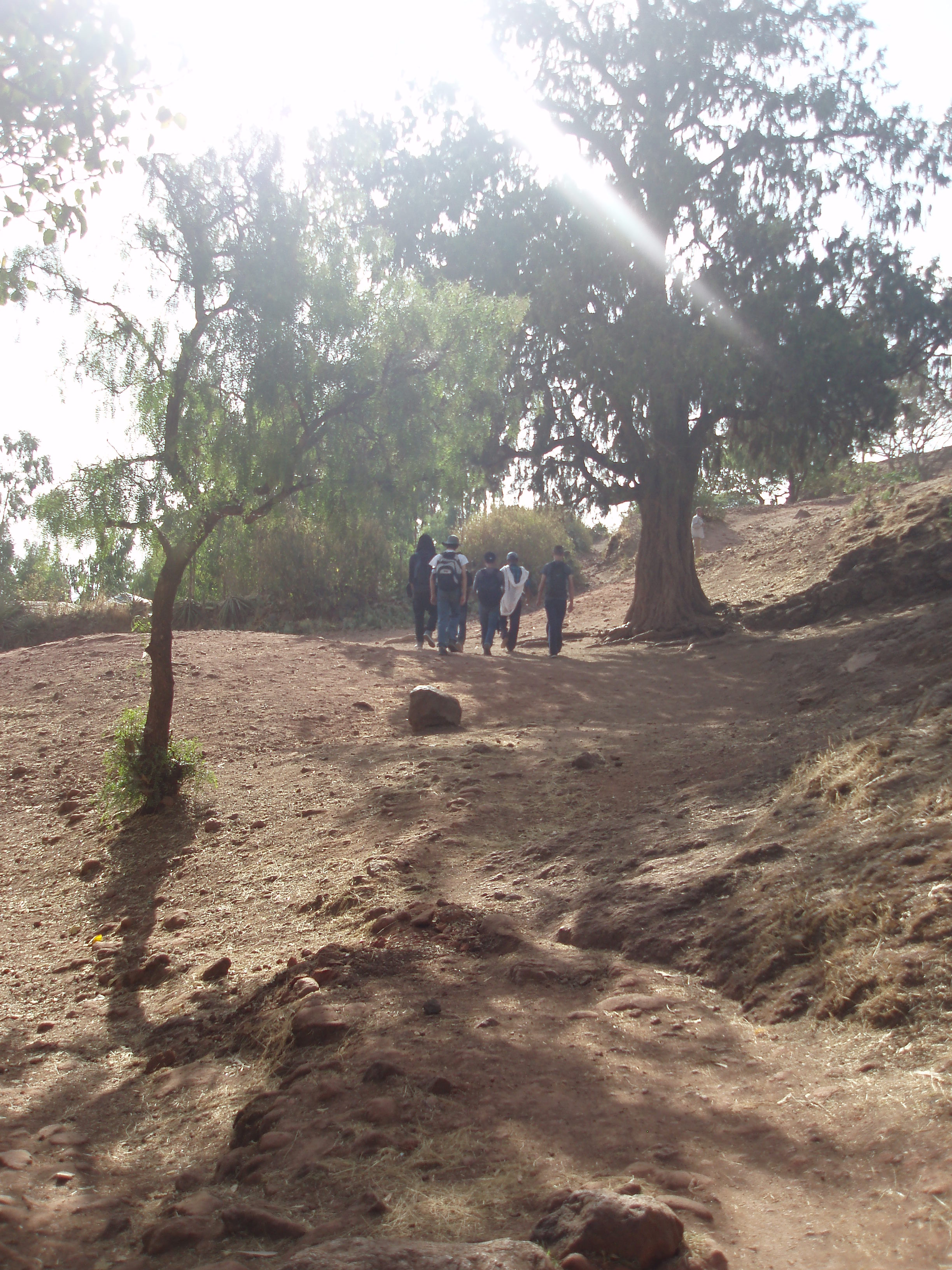
OLYMPUS DIGITAL CAMERA

Posted in Around Ethiopia, Background, Ethiopia, International Community School | Tagged , , , , | 2 Comments

White man dancing

I have written at length about the culinary nirvana that is Ethiopian food, so I won’t repeat myself here (not today, anyway).  My uninitiated American friends can find out where to find the good stuff if they scroll to the bottom of  this post from my old blog, Foodlandia.  Although very few of my American friends are uninitiated because over the years I have dragged almost all of them to an Ethiopian restaurant somewhere.

You might want to know that if you should decide to visit us here in Ethiopia, we will drag you to an Ethiopian restaurant here, too.  Probably several of them.  I suppose you will go willingly because, after all, you did come all the way to Ethiopia to find out what’s the what in Addis. But at least one meal will have to be at what they call a “cultural restaurant” – one that serves the full complement of dishes in the traditional manner.  It will also have a dance show.

We hosted a visiting author last week at ICS:  Bruce Coville, author of (among many other children’s titles) Jeremy Thatcher, Dragon Hatcher.  A group of teachers took him to Dimma, the faculty favorite among the cultural restaurants.

IMG_2868

Bruce (on the right) with some of our ICS colleagues.

Watch out when you go to Dimma.  They will drag you up on stage where you will dance, Ethiopian style, to the best of your abilities and to the great amusement of your dining party. Then someone will post the video on the Internet.

Posted in Addis Ababa, Ethiopia, Family, Food, International Community School, Teaching | Tagged , , | 1 Comment

Beware the ides of March

Andreas led a 6th grade field trip to Menagasha today.  They toured the Born Free foundation, a wild animal rescue non-profit that operates in a number of locations around the world.  Here in Ethiopia they run a shelter for exotic animals that have been kept as pets or exhibited for profit.

Somewhere between the lions and the cheetahs, Andreas stepped on this:

thorn

Ouch.

Luckily the school always sends a nurse or a doctor along on these trips (this time it was a vet, but that’s close enough). They washed up his foot and sent him home with the thorn branch just in case it has to be tested by a communicable disease lab.  He’s had a tetanus shot, so we figure he’ll be all right.

Posted in Animals, Around Ethiopia | Leave a comment

Let’s do the time warp again

Remember that post I wrote about the Ethiopian calendar?  It’s a little strange to find ourselves in 2005 again.  Here’s another oddity of the space-time continuum – Ethiopians don’t measure daily time the way we do in the west, either.

The Ethiopian clock is 6 hours different from our clock.  I am not talking about time zones.  I mean that if we start school at 8 am faranji time, that is 2 in the morning Ethiopian time.  The Ethiopian clock is divided into 24 hours like ours, but instead of starting the new day in the middle of the night as in the West, here the changeover occurs at what we would call 7 am, and what Ethiopians call 1 o’clock (well, here they actually call it ahnt se’at ke tewatu.) – so another difference is that the hour between 12 and 1 belongs to the previous day.  Confused yet?

Luckily ICS uses the western style of timekeeping, so we don’t have to maintain two sets of clocks to get ourselves to work on time.  But it is essential to recognize the difference when making plans with taxi drivers, housekeepers, and other local people.  We always specify faranji time or Ethiopian time.

We don’t do daylight saving here; at least once we figure out how to set the clocks, we can leave them that way.

lion_of_judah_wall_clock

Just forget the whole thing and buy an Amharic clock with no numbers.

Posted in Ethiopia | 1 Comment

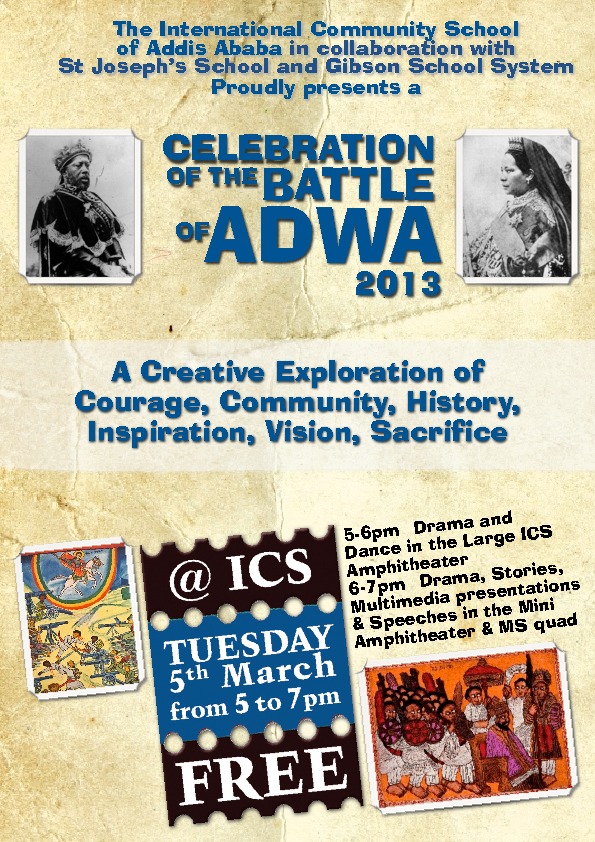
Battle of Adwa

BoA poster2jpg

Last night our school commemorated one of the most important events in Ethiopian history: the defeat of General Oreste Baratieri’s Italian army by Emperor Menelik II’s Ethiopian forces at Adwa on March 1, 1896.

A little background: By the late 1800s, every country in Africa was under colonial rule except Liberia and Ethiopia.  The Italians were late to the colonization party but had by then annexed Somaliland and Eritrea, both bordering Ethiopia.  The addition of Ethiopia would position Italy as a solid colonial power.

The Italians had made a treaty with Menelik in 1889 that turned out to read differently in Italian and Amharic.  The Amharic version said that Ethiopia would give certain areas over to Italy in exchange for independence; the Italian version said that all foreign affairs had to be transacted through Italian authorities.  The First Italo-Ethiopian War ensued.

I won’t get into the whole story of the final battle of that war. The gist of it is that the Italians thought they had a sure thing at Adwa, but it turns out that they made some fatal tactical errors. One of those was seriously underestimating the Ethiopian army.  When it was all done, Menelik II had preserved Ethiopia’s independence and the country was recognized from then on as a sovereign state.  Lesson learned: don’t mess with Menelik.

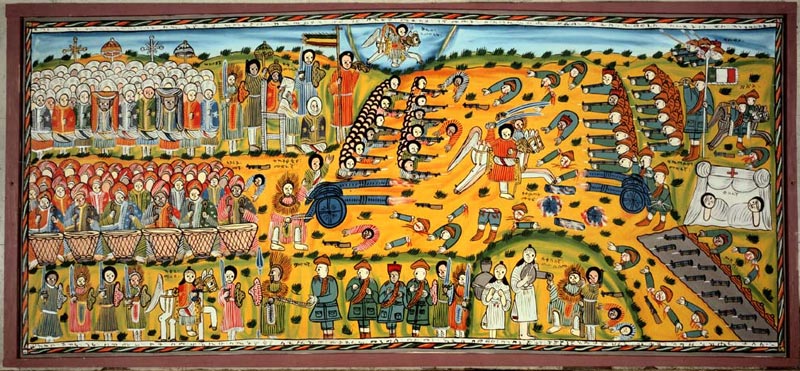
adwa library of congress

A painting of the battle in the US Library of Congress

I found an interesting take on Ethiopian history in this blog post.  I have no idea who the author is and I’m not going to vouch for the absolute truth of anything he says, but if you don’t mind strong opinions and a few f-bombs then you might be entertained.

A popular Ethiopian singer, Teddy Afro, recently produced this music video celebrating the Battle of Adwa.  Students here were playing it on their laptops a lot this week.

Posted in Background, Ethiopia, International Community School | Leave a comment

Shameless self-promotion

Hurray for me!  Not only have I posted exactly 100 entries in Lorna of Arabia, but I got picked for blog of the month at the website Expat Blog.

expat blog logo

Click here to read the interview

Posted in Expat experience | 3 Comments

New After School Activity

Ukulele Club
Tuesdays
Grade Levels: 6-12
Location: room 67

Learn some basic chords and strumming patterns; play some songs in a group and individually. Ukuleles are fun, so the idea is we will have some fun and make some good noise. You will need your own ukulele.

Shoot.  I knew I forgot to pack something.  I guess Alekka will have to find something else to do on Tuesday afternoons.

Posted in International Community School | Tagged | 2 Comments

A run for the money

OLYMPUS DIGITAL CAMERA
ICS held its 4th annual Charity Walk & Run this last Saturday.  The event is a fundraiser for three excellent local charities.  ICS students and teachers volunteer throughout the year with these organizations, but the annual run is special in that it involves the entire school community.

on your marks

On your marks

ICS families and friends came out and made a day of it.  The three charities had information booths where they sold tshirts and other items. There was a hamburger barbecue at the snack tukel and a Jamaican jerk chicken hut.  There was music. There were also lots of Norwegians: forty supporters of the Children’s Burn Unit flew in from Oslo for the event.

??????????????????????

Norwegians lined up to get team shirts

stuffed wolves closeup

EWCP sold these stuffed Ethiopian wolf toys. Yes, of course I got one.

Alekka’s not a runner, so she helped by making signs and working in the student council’s water sales booth.  I’m not a runner either, so I walked for a flat donation.

??????????????????????

Get your burger at the tukel.

Last year’s run brought in 810,000 birr (that’s almost $44,000)  for the charities.  The pledges aren’t all in yet but it looks like this year we surpassed that amount. There should be updates on the Walk & Run site if you want to check back.

donation box

Links to information about the charities:

The Ethiopian Wolf Conservation Program

Working to save this critically endangered species. There are only about 500 left, all of which live in the Bale mountain region of Ethiopia.

Our Father’s Kitchen

A local restaurant provides a daily meal to hungry children in Addis Ababa.

Children’s Burn Care Foundation

A Norwegian doctor builds the only specialized burn care for Ethiopian children.

Posted in Addis Ababa, International Community School | Tagged , , , , , , , | 2 Comments

Ish

“Ishee” is a word in Amharic.  When spoken, it is usually followed by a sharp, audible intake of breath for emphasis.  Although sometimes it just sounds like “ish”.  And sometimes it’s just the breath.

Ish or ishee means something like “OK” in English.  If you think about it, Americans are always saying OK.  We say it when we mean good, or acceptable, or I agree, or I will do that, or I understand what you’re saying.  Ish is the pretty much the same.  If you are talking to an Ethiopian, instead of nodding and saying OK, they will do the breath thing and say “ish” a lot.

The first extended conversation I had with an Amharic-speaking Ethiopian was with our housekeeper, Etsegenet.  She came to our apartment on our second day in Addis to meet us and find out about her new schedule.  We thanked her for the spaghetti sauce and salad she’d made and left in our refrigerator, and for the supplies she’d bought and stored in the cupboards.

As we talked, I became convinced she had some kind of unusual speech impediment, exacerbated by having to communicate with a pair of jet-lagged English-only faranji who held her employment future in their hands. I didn’t realize until several days later, after meeting Ethiopian staff at the school, that this is what everyone sounds like.

Now that I’ve been here for half a year, I don’t notice the “ish” thing at all.  Instead it’s the the few words of Amharic I know that jump out at me. Funny what you notice, and how it changes.

ish

From One Fish Two Fish Red Fish Blue Fish – Happy birthday Dr. Seuss (March 2)

Posted in Ethiopia | Tagged , | 3 Comments

Menegasha forest

Last Saturday we took the faranji-mobile out for a little local exploration.  Our destination was the Menagesha forest, about a 40 minute drive southwest of our home.

The forest is Ethiopia’s oldest park – in fact, it lays claim to being the oldest park in all of Africa, having been established as a protected reserve or “crown forest” by Emperor Zera Yacob in the mid-1400s  It’s not totally wild; sections in the lower areas a filled with trees growing plantation-style in straight rows. But higher up is the old-growth area with big trees and lush undergrowth.

To get there, we drove on paved roads through the farmlands and small villages outside of Addis to the town of Sebeta, where we turned off onto a wide dirt road traveled mainly by horse-drawn gharries, and livestock, and women and children carrying wood and water.  At the edge of the forest we turned onto a much narrower track leading up into the park.

This slideshow requires JavaScript.

The road going up is so rough and rutted I can’t imagine that it is even passable in the rainy krempt season.  We tried out the truck’s 4-wheel drive feature (works great!) before we finally gave up and parked.  We continued on foot for a couple of miles to a high point from which we could look down on the forest and the surrounding farmland.  I was pretty pooped by the time we got that far, so Alekka and I sat and enjoyed the view while daddy-bear continued over the mountain to see what he could see (he saw a waterfall).

We know there are animals in the forest, but we didn’t have much luck finding them this time.  We did spot a Menelik bushbuck as we started up the hill, and several interesting and colorful birds, but we were probably making too much noise to see the colobus monkeys or baboons that live there.  The trees are mainly giant junipers and something called zigba; some of them are over 400 years old.  All around are lobelia and other exotic looking plants.

This slideshow requires JavaScript.

The park has a couple of semi-improved car camping areas with firepits and barbecue grills.  Maybe another time if we spend the night we’ll see a leopard.  We know they’re here.

Posted in Around Ethiopia, Ethiopia | 2 Comments